Wednesday, January 27, 2010

Gas pipelines in Western Siberia and prices of gas

With the following post, we want to complete the previous information given about gas pipelines in Yamal Peninsula and Western Siberia. In the following link a detailed scheme of gas pipelines in Western Siberia is provided.

A complete report about gas prices in Russia can be obtained via East European Gas Analisys.

Thursday, January 21, 2010

EU Project Tundra

We are pleased to present you one of the most relevant projects carried out in the scientific community about environment and climate in the tundra region. The TUNDRA project is supported by the Environment and Climate Programme of the European Commission, Climatology and Natural Hazards.

TUNDRA stands for Tundra Degradation in the Russian Arctic. It is a research project funded for a period of 3 years (1998-2000) by the IVth Framework 'Environment and Climate' Programme of the European Commission. TUNDRA studies the effects of Global Change in the East-European Russian Arctic. The magnitude of expected climatic changes and the fragility of the environment make the Arctic a priority area to study the effects of global change.

The main focus of TUNDRA is to assess feedback processes to the global climate system that originate in the Arctic. Emphasis is given to changes in greenhouse gas emissions to the atmosphere and in freshwater runoff to the Arctic Ocean taking into account Global Warming, industrial pollution and the public perception of environmental degradation. The project is interdisciplinary in nature and involves climatologists, soil scientists, ecologists, palaeoecologists, hydrologists, pollution specialists and social anthropologists from Denmark, Finland, Russia, the Netherlands and the United Kingdom.

Tundra project in the web

Tuesday, January 19, 2010

Siberia’s Arctic landscape is getting greener

Every spring the Arctic bursts into bloom, turning a blinding white landscape green and brown. In recent years some parts of the Arctic have been getting greener, with Northern Alaska showing a 20% increase in summer greenness since 1982. Some blame climate change for the flourishing vegetation, while others believe that disturbances to the land, such as gas-field development and reindeer grazing, could be a partial cause. A new study shows that the answer isn’t simple.

Scientists measure the greenness of a landscape using light-reflection data gathered by weather satellites. Green plants tend to reflect the near infra-red wavelengths, but absorb red wavelengths for photosynthesis. Using near-infrared and red-wavelength data scientists calculate a "normalized difference vegetation index" (NDVI), where higher numbers represent greener landscapes. This measure provides a good reference for year-to-year change of the amount of tundra productivity over the past 25 years.

To better understand the trends in tundra productivity and how this might be related to the dramatic changes in sea ice that are occurring in the Arctic Ocean, Skip Walker from the University of Alaska and his colleagues have studied 25 years' worth of sea-ice data, summer land temperatures and NDVI values from the Yamal Peninsula, in north-west Siberia.

The Yamal region is an ideal place to understand NDVI because it is relatively flat and simple geologically, the vegetation structure is straightforward and it is a hotspot for Arctic land-cover change. What's more, there is a strong north-south climate gradient along which it is possible to study the effects of climate on greenness patterns.

By studying the satellite data the team found that there had been a 7% increase in NDVI over the Yamal Peninsula between 1982 and 2007. Over the same time period the researchers saw a 37% decrease in summer sea-ice concentration around the peninsula, and a 4% rise in summer land temperatures.

Previously Walker and his colleagues had hypothesized that the melting sea ice might be causing a rise in land temperatures and encouraging vegetation to grow but this appeared to be only part of the story on the Yamal peninsula. "The linkages between sea-ice decline, land temperatures and NDVI are not as strong on the Yamal as they are in other areas of the Arctic, which led us to examine other factors such as disturbance,"

Continue in "Environmental research web"

Wednesday, January 6, 2010

Daily life of tundra nenets

Happy New Year!! After some days of rest, we retake the activity in the blog with an interesting photo documentary of one day in tundra nenets life.

With a population of over 41,000, the Nenets are one of the largest of the indigenous groups in Northern Siberia. Their territory covers a vast area that stretches from the Kanin Peninsula at the White Sea in the west, all the way to the Taymyr Peninsula, a distance of more than 2,000 km. Nowadays most Nenets live in northern areas of the Yamal-Nenets Autonomous District and the Nenets Autonomous District. The Nenets are comprised of two distinct groups the Tundra Nenets who live in the North, and the Forest Nenets, a much smaller group of around 2,500, who live in the forests to the south.

The Nenets belong to the Samoyed group of peoples. Their ancestors originated in Southern Siberia and are believed to have settled in the Russian North about 1000 years ago. The first written reference to them was made in 1096 in Nestor’s chronicles. Traditionally the Nenets are reindeer breeders, who also hunt, trap and fish. The Nenets who lived in coastal areas also hunted sea mammals but reindeer is the basis of their culture providing food, clothing, shelter (skin tents) and transport.

In the following link you can find the photo gallery and more detailed information about tundra nents.

Photo Gallery

Information

Thursday, December 17, 2009

Chinese Communities in Western Siberia

Chinese immigrant communities were established in the Russian heartland (Western Siberia) during the interwar period (1920s-1930s). Chinese -primarily male groups - had managed to adapt peacefully, though temporarily, into the local environment due their particular mentality and social features: they were often occupying free labour and demographic lacunae, caused by the losses of men in WWI/Russian civil war and devastation of economy/infrastructure. The growth of authoritarian tendencies under the Stalinist regime in Soviet Union, economic shortcomings and the ethnic purges of 1930s closed the agenda of Chinese presence in the western Siberian, as well as in the whole Soviet scene. Actually all persons of Chinese origin were accused of being 'outside' (Japan's) collaborators, and they were assassinated or, at best, forwarded to concentration camps. Just a few survived. The Chinese in Western Siberia represented a very particular sociodemographic and ethnical phenomenon, remarkably distinctive from other similar, Russian Far East or worldwide, immigrant communities.  

Cross-border migrations between Russia and China are among the most actual problems of contemporary Russia-Chinese relations. Their history and dimensions have been shaped by the neighbouring positions of the two states and also by objective economic factors. The social-political situation on either side the border has also played a crucial role in determining the character, direction and 'algorythm' of these migrations. Historically it came about that the main form of migrational interaction between Russia and China was the movement of Chinese into the spacious regions of the Russian Far East and Siberia. The specifics of this presence, its socio-demographic structure and its possible consequences require further research and analysis. One element of such an analysis is the exploration of the history of Chinese immigration into Russia, specifically into West Siberia. We should note that this subject has not been well studied, either by Russian or foreign scholars, because of its political sensitivity and the lack of access to sources.

 At the end of the nineteenth and the beginning of the twentieth century, there were only just over 40,000 Chinese in the region. Very few of them lived in the southern and western parts of this vast area. The situation changed significantly during the years of the First World War and the 1920s. Hundreds and then thousands of Chinese migrants attached themselves to the hitherto tiny islands of Chinese scattered in the large cities of Western Siberia. They were mostly contract workers on war-related projects and seasonal workers. A great proportion of them were entirely taken up with the problems of their own survival, while others were directly drawn into the internal Russian military conflicts caused by the revolutionary events of 1917 and the deep crisis in the country. These Chinese migrants were mostly people from the lower social layers. They voluntarily entered the international brigades of the 3rd and 5th Red Armies, which were active at the time on the Eastern front. They revealed themselves to be brave fighters, which caused them to be much detested by their opponents. It is known that brutal punishments of Chinese prisoners of war from the Red Army were carried out by Kolchak's troops. In the winter of 1918, for example, at the station of Tyumen, two hundred people had their clothes removed and were then sent off naked to a distant prison camp. Only forty of them survived.

If you are interested, you can find more interesting and detailed information in the article presented by Mr. Boyko at the International Conference of Institutes and Libraries for Overseas Chinese Studies. 

Monday, December 14, 2009

Unique bridge crossing over Yuribey in Yamal

The bridge crossing over the Yuribey River, a part of the Obskaya – Bovanenkovo railroad. The Bovanenkovskoye field with its ABC1+C2 gas reserves totaling 4.9 trillion cubic meters is the largest gas field of Yamal. The new railroad thoroughfare designed to connect Yamal’s fields with the transportation infrastructure of northern Ural, will become a crucial component of the national strategic project – the Yamal Peninsula’s fields development. The year-round delivery of cargoes, equipment and workforce to develop Yamal will enable to rapidly form on the Peninsula a new gas production province of a fundamental importance for Russia’s gas industry development over the next decades.

This is a unique construction unparalleled in the global practice of bridge building. The crossing with the length of approximately four kilometers is the longest bridge beyond the Polar Circle. Its operating life accounts for 100 years. The bridge crossing over the Yuribey River floodplain is the most complicated section of the Obskaya – Bovanenkovo railroad. It is the world’s longest bridge beyond the Polar Circle and is unparalleled in the global bridge construction practice both in terms of design and the climatic and permafrost conditions of construction and operation (permafrost soil and high degree of bogginess). The crossing has the length of 3.9 kilometers, the total weight – over 30 thousand tons, the operating life – 100 years.

The most advanced technical solutions were applied during the construction process in the aim of preserving the floodplain ecosystem of the Yuribey River. In particular, the crossing was constructed avoiding the traditional deposition of soil, which enabled to retain the floodplain’s original environment.

The construction is mainly specific for the crossing arms. To secure their reliability the arms were made of 1.2–2.4 millimeters metal pipes, buried into the wells drilled under the permafrost conditions at the depth of 20–40 meters and filled with armored concrete. The innovative technologies developed by Russian scientists and engineers enable to protect the permafrost soil from thawing.

Source of information: Gazprom

Friday, December 4, 2009

Vegetation of West Siberia

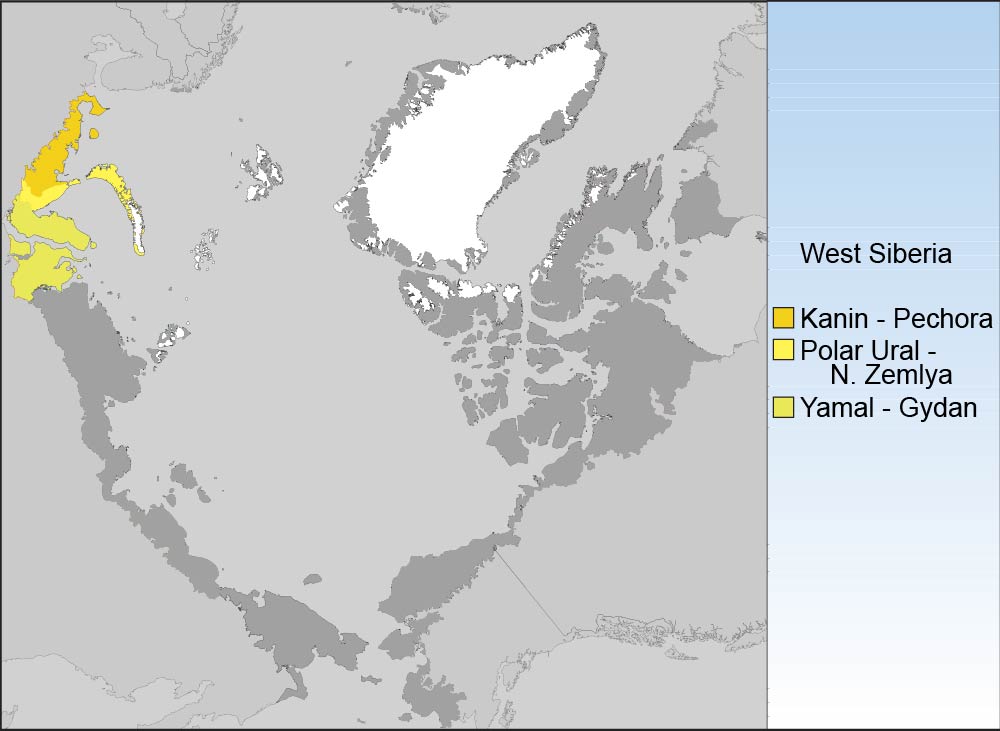
Yurtsev (1994) states that this group " …covers the whole West Eurasian sector of the true Arctic (from 67° to 82° N); it is subdivided into [three] subprovinces, each corresponding to a major geomorphological unit. They form a natural swarm, its 'nucleus' being the mountain axis Ural-Pay Khoy-Novaya Zemlya, which runs through several vegetation zones from steppe into polar desert."
"The obvious negative features of the province are: the absence of (1) East Siberian, East Siberian-North American and North American species: (2) North Atlantic Hypoarctic and boreal species (and Arctic-alpine species such as Alchemilla alpina); (3) boreal and even boreal-nemoral taxa, e.g. Calluna vulgaris and Nardus stricta. There are few endemic and other differential taxa in the province or its subprovinces, i.a. Gastrolychnis angustiflora s.s., Papaver lapponicum ssp. Jugoricum, Pedicularis dasyantha, P. sudetica ssp. arcto-europea. The longitudinal floristic gradient is complicated by an 'inversion' in the Ural-Novaya Zemlya subprovince where the East Siberian species (and partly, the amphi-Atlantic) are better represented than in the adjacent lowland areas (Igoshina 1966). The presence of species of the genera Alchemilla, Euphrasia, Gnaphalium, Hieracium etc. is a distinctive feature of the Atlantic sector. The flora of this province was subjected to the destructive action of Quaternary marine transgressions and glaciations (Tolmachev 1970) as well as to the expansion of forest and shrub vegetation. Most favorable for the dispersal of Siberian and East Siberian continental elements was the cold and dry period of the Late Pleistocene, synchronous with the great sea regression." (From Yurtsev 1994.)
  • Karnin-Pechora sector: "Here we find most northward extensions of boreal species (in particular European), even on the Kolguyev Islands. The Arctic and Arctic-alpine complex is impoverished, endemism is very poor and of a low rank (e.g. Gentiana arctica, Koeleria pohleana). Some oceanic species penetrate, e.g. Calluna vulgaris, Ligusticum scoticum and Primula farinosa into the western parts of the subprovince and of continental species, e.g. Astragalus umbellatus, Salix nummularia and Trifolium lupinaster, into the eastern parts (of the Ural). Few East Siberian species—absent in the West Siberian lowland and present in the Ural Mts.—occur sporadically, e.g. Crepis chrysantha and Silene paucifolia." (From Yurtsev 1994.)

Gentiana arctica

  • Polar Ural-Novaya Zemlya sector : "The mountainous relief and the diversity of rocks and the expansion of forest and shrub vegetation favoured the preservation of various, sometimes contrasting flora elements. The barrier function of this mountain chain between the Siberian and European floras was of less importance. The montane floras of the [sector] typically show the floristic features of the Nenetsk province: European and amphi-Atlantic oceanic on one hand, and Siberian (boreal, continental Arctic, Arctic-alpine and Hypoarctic species) on the other, coexist. This subprovince includes the western foothills of the Polar Ural Mts. east of the 'Ruprecht line' (Rebristaya 1977) and is characterized by the highest richness within the province. This is due to: (1) overlapping distribution areas of western and eastern species; (2) far southward extensions of Arctic and even High Arctic species; (3) a distinct longitudinal floristic gradient (differences between the European and Asian slopes of the mountain range) and a more gradual latitudinal gradient. Several endemics arose from hybridization between Siberian and European taxa, e.g. Trollius x apertus = T. europaeus x T. asiaticus. The level of endemism is slightly higher here than in the adjacent subprovinces. Endemics of East Siberian affinity are e.g. Astragalus gorodkovii, A. igoshinae and Taraxacum platylepium." (From Yurtsev 1994.)

Trollius apertus

  • Yamal-Gydan sector: "This [sector] contrasts with the previous [sector] in terms of a low floristic richness in association with various negative features of its flora: the gap in the distribution areas of many montane, predominantly East Siberian species; the absence of scores of 'eastern' (trans-Yenisey) species along with western ones (European, amphi-Atlantic, etc.) reaching the Ural Mts. Many 'western' species are confined to the lower Ob drainage up to the Taz Peninsula, and are lacking in the Gydan Peninsula; some of them are also recorded outside the Arctic from the mountains on the right bank of the Yenisey River. Most of the western elements are restricted to the southernmost areas whereas the role of the eastern counterparts increases northwards. Endemism is almost totally lacking here." (From Yurtsev 1994.)


Via Toolik-Arctic Geobotanical Atlas (TAGA)